Mogadishu
Black Hawk DownMogadishu is both the setting of the 1993 raid and a decisive force in its course: a city scarred by civil war, where narrow streets, damaged buildings, and crowded public spaces complicated the American operation and brought combatants and civilians into close proximity.
City and wartime setting
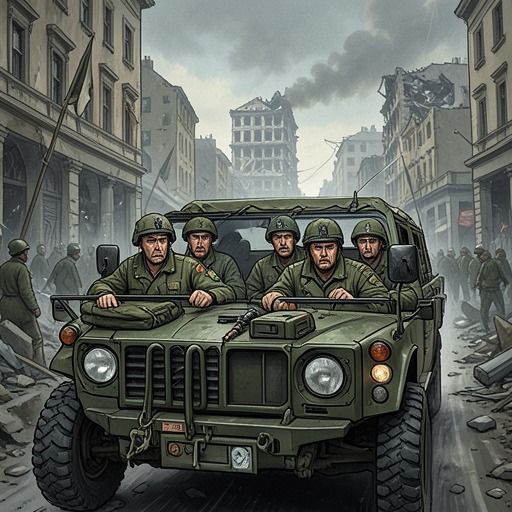
By October 1993, five years of civil war had transformed Mogadishu from a picturesque African port into a city of crumbling avenues, mountains of trash and debris, and buildings marked by bullets and cannon fire. The damage was not merely a backdrop. It shaped movement and visibility, while the city’s dense neighborhoods offered places to take cover and routes from which armed Somalis could approach the fighting.
The raid unfolded in the Bakara Market area, a stronghold of support for Mohamed Farrah Aidid. On October 3, American forces set out to capture two of his lieutenants. The plan sent commandos to storm a target house while Rangers descended by helicopter to secure the surrounding block; a ground convoy was meant to carry the American forces and prisoners back to base. From the air, however, the city already presented two contrasting faces: broad signs of devastation, and a busy neighborhood near the Olympic Hotel that appeared to be in better condition than most of Mogadishu.
The streets around the target house made the operation’s geometry consequential. Hawlwadig Road ran north to south in front of the Olympic Hotel, crossed by narrow dirt alleys where drifting sand turned rust-orange in the afternoon sun. One block north of the hotel, across the road, stood the target house: an L-shaped building with a high-walled courtyard, three stories at the rear and two at the front. Cars, pedestrians, and donkey carts moved outside it as the assault began, placing the military objective within an active neighborhood rather than an isolated compound.
Civilians within the fighting
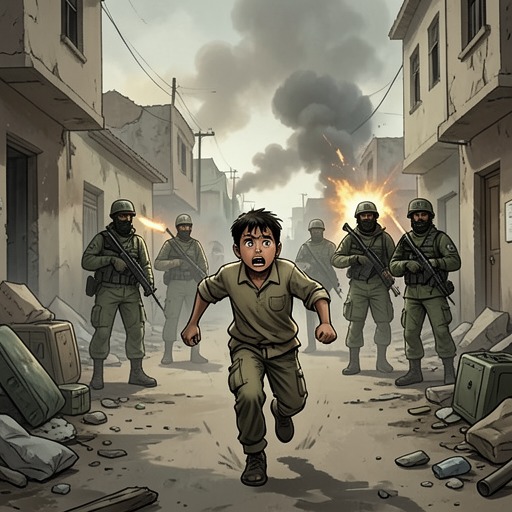
The city’s streets brought armed resistance and ordinary residents into the same narrow field of action. The Rangers had strict rules of engagement: they were to fire only at someone pointing a weapon at them. Yet armed Somalis moved among women and children, while residents of all ages gathered to witness disturbances. As the crowds closed in and shots came from alleys, the distinction the rules required soldiers to make became increasingly difficult to apply in the moment.
A convoy encounter made that difficulty painfully concrete. A woman in a flowing purple robe ran beside a truck with a baby on her arm. Eric Spalding first shouted to the driver not to shoot because she had a child; when the woman turned and raised a pistol with her free hand, Spalding shot her, then fired four more rounds as she fell. The convoy was moving too fast for him to see whether the baby had been hit, and he believed it probably had. The episode joined an immediate threat to an unresolvable civilian consequence, without allowing the soldiers time to establish what had happened to the child.
As the column fought back toward base, the rules of engagement were abandoned. Ranger Sizemore saw boys, some armed and some not, and shot them; he also fired into crowds of women running alongside men with rifles. The account describes him as numb, angry, and intent on protecting his fellow soldiers, but that immediate battlefield impulse did not erase the civilians among those killed. The city’s crowded streets thus registered not only how the fighting spread, but how the soldiers’ response changed as fear and losses accumulated.
For residents, the violence was experienced in fragments of exposure and flight. Abdikarim went toward the market seeking news of relatives and found dead men, women, and children in the road. He saw an American soldier bleeding by the roadside, then a woman hit by American gunfire as she ran across the street; moments later a Little Bird helicopter fired down an alley while Abdikarim pressed against a stone wall. Armed Somali men then ran toward the corner to shoot at the American. Abdikarim retreated to a friend’s house, where people stayed on the floor through a night of shooting without sleep. His route through the neighborhood shows civilians not as a single crowd, but as people trying to locate family, interpret danger, and find shelter amid opposing fire.
Crash sites and the citywide battle
The city’s narrow streets became more than routes through the raid: they divided the American force into exposed groups and made the downed aircraft the center of a desperate effort to recover the men and the dead. At the Joint Operations Center, surveillance cameras showed Super 61 moving smoothly before smoke appeared near its tail rotor. The helicopter spun downward, struck the top of a stone building, then smashed sideways into a narrow alley. Its rotors broke apart as the fuselage hit the wall amid smoke, dust, and debris. The crash was visible live to the command staff, but its consequences extended far beyond the aircraft and its six men: the wreckage marked a sudden crisis in the American mission to Somalia.
Around the crash site, Rangers and commandos were pinned beneath small-arms and rocket-propelled-grenade fire. Several groups had gathered along a wide street that bent into an L at the intersection, while the search-and-rescue team worked at the wreck to collect wounded men and extricate pilot Cliff Wolcott’s body. The street’s shape and the surrounding buildings offered cover, but also left soldiers concentrated under fire. Paul Howe led men through a courtyard gate between two houses to get them off the exposed street; inside, they found a family sheltering together. The Americans searched the residents, handcuffed them, and moved them to a side room as they tried to establish a defensible position.
As darkness fell, the city’s cramped layout magnified the difficulty of command. Ninety-nine men were scattered through the streets around the wreck, and the commanders argued over the radio about where to assemble them. Scott Miller wanted Mike Steele to move the men sheltering with him one block north; Steele hesitated, while Gary Harrell supported concentrating the force near the crash site so it could establish crossfire positions and give the helicopter gunships clearer targets. The debate arose from the same urban conditions that shaped the fighting: groups were separated by blocks, exposed to fire from surrounding streets, and difficult to gather into a coordinated force.
The battle also reached Somali homes and shelters far from the Americans’ intended route. On the morning of October 4, injured captive pilot Michael Durant lay in a small, windowless octagonal room, where air and daylight entered through crosses cut into the concrete walls. Children’s voices and birdsong outside contrasted with the violence of the previous evening, when Somali fighters had overrun his downed helicopter crew and the two commandos who defended them. Durant did not yet know that the others were dead. The room’s ordinary sounds and enclosed walls gave the city’s aftermath an intimate scale: the battle was not only a contest around aircraft and intersections, but a force carried into the places where people hid and captives were held.
The fighting’s final toll made Mogadishu the setting of a military defeat with consequences well beyond its streets. Eighteen Americans were killed and 73 wounded; more than 500 Somalis died and at least a thousand were injured. The operation had been launched to capture Omar Salad and Mohammed Hassan Awale, men who remained little known after the battle. Several weeks later, Bill Clinton accepted Robert Oakley’s plea on behalf of Somali leaders and ordered the release of every Somali captured by Task Force Ranger. The American mission effectively ended, and all the soldiers who had fought in Mogadishu were home within a month.
The battle’s uneven geography
The fighting did not occupy Mogadishu uniformly. Only blocks from the airport, gunfire stopped and open-air markets carried on: people strolled and chatted as the battered convoy approached. The crowds parted to let the damaged vehicles pass, then turned toward the soldiers and applauded. That abrupt shift—from streets where civilians and fighters had been caught in lethal close combat to a market seemingly untouched by it—made the city’s divisions visible without resolving what the applause meant. Mogadishu was at once a battlefield and a place where daily life continued, sometimes only a short distance from the wreckage.